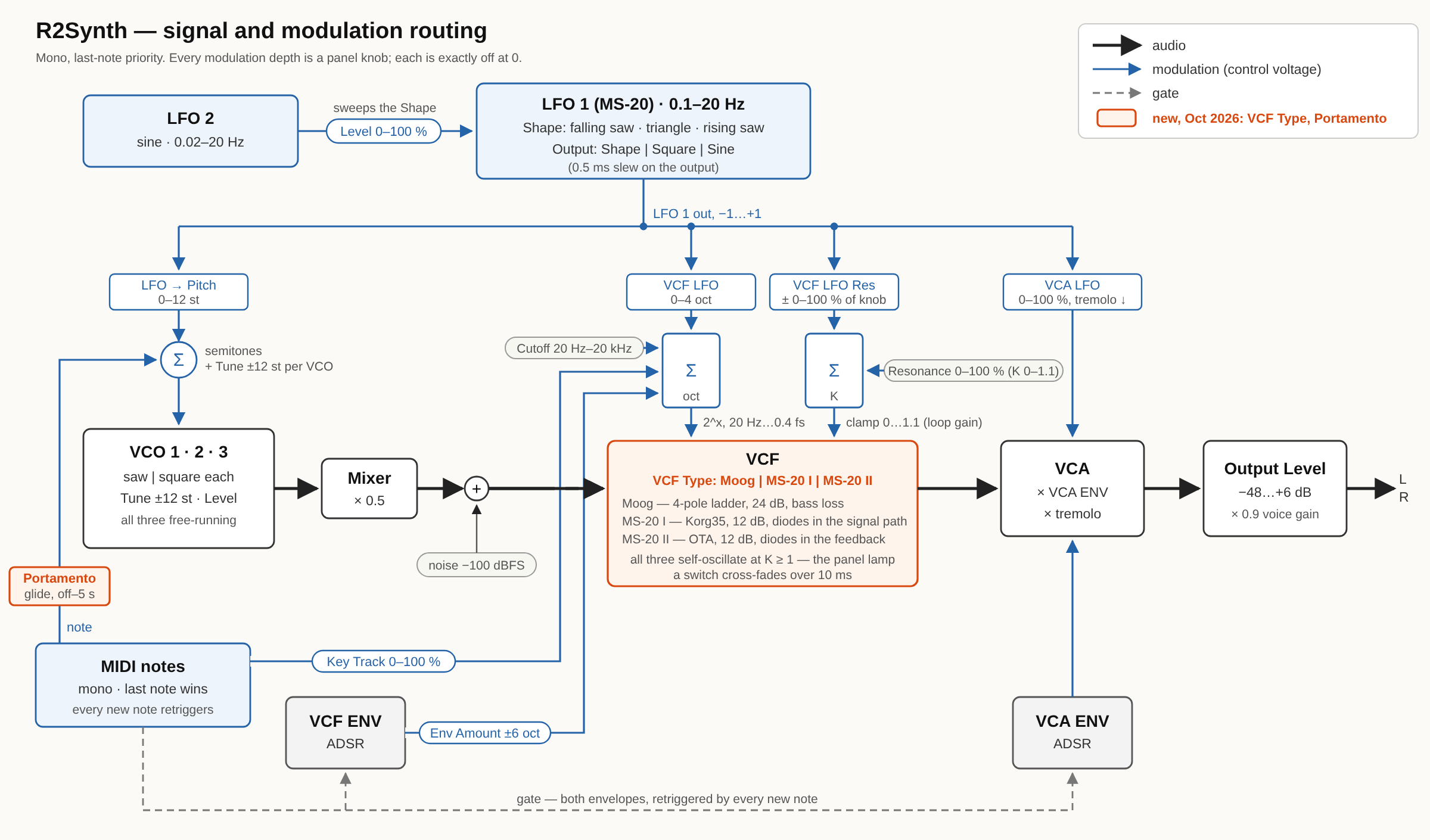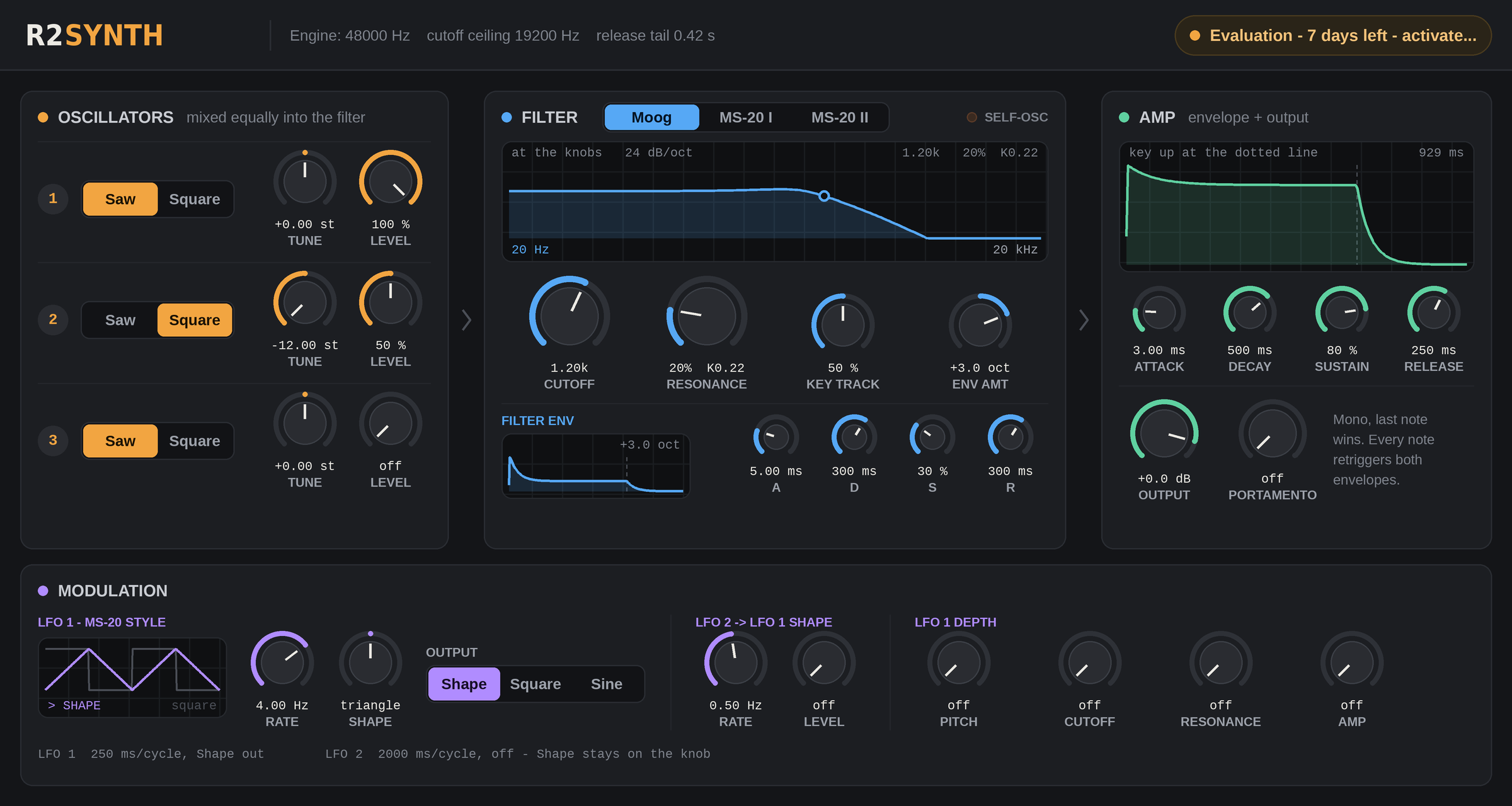
R2Synth is a monophonic analogue-style synthesiser: three oscillators, a filter, two envelopes and two LFOs, laid out on the panel in the order the sound travels through them. Its centre is a filter you can switch between a Moog ladder and either of the two Korg MS-20 filters — while a note is playing, if you like.
33 parameters, all automatable. One stereo output, no audio input. The default patch peaks at about −7 dBFS.
The oscillators
- Three VCOs, each sawtooth or square, each with its own Tune (±12 semitones, continuous) and Level. All three are free-running, so detuning two of them a few cents apart gives the slow beating you would expect.
- The waves are band-limited with polyBLEP, so high notes do not alias into a fizz of wrong frequencies.
- The three are mixed equally into the filter.
The filter
The VCF Type switch in the filter's title row picks one of three:
- Moog — a four-pole, 24 dB/octave ladder, using SpaceDub's per-sample arithmetic with two additions. It is tuned: the resonant peak lands on the Cutoff frequency to within about a cent at every sample rate. And Resonance self-oscillates at the same point on the knob at every cutoff, rather than earlier at some frequencies than at others.
- MS-20 I — the early Korg35 filter, 12 dB/octave, with its diodes in the signal path.
- MS-20 II — the later OTA design, 12 dB/octave, with the diodes in the feedback.
Switching cross-fades over 10 ms, so it does not click and can be done mid-note. All three self-oscillate, and a lamp on the panel lights when they do. The display above the knobs draws the filter's response live, so you can see what Cutoff, Resonance and the type switch are doing.
Cutoff runs from 20 Hz to 20 kHz, with Key Track (0–100 %) and a filter-envelope Env Amount of ±6 octaves.
Envelopes and playing
- Two ADSRs, one for the filter and one for the VCA. Decay and release times are the time to fall to −60 dB. Each envelope restarts from wherever it is, so a retrigger never clicks.
- Mono, last-note priority. Every new note retriggers both envelopes, and letting go of a key returns to the last key still held — the MS-20's keyboard behaviour.
- Portamento, from off to 5 seconds. When it is on, every note glides from the last one, whether you play legato or not.
- Output Level, −48 to +6 dB.
Modulation
LFO 1, after the MS-20
One Shape knob sweeps the wave from a falling sawtooth, through a triangle, to a rising sawtooth, and the square output's duty cycle follows the same knob, as the MS-20's modulation generator does. A third output, Sine, rounds the triangle with a differential-pair (tanh) shaper, the way the EMS VCS3 makes its sine; as on the VCS3, the same knob pushes that shaper off balance towards a lopsided, rectified-sine shape at either end. The Output switch picks which of the three is used, and the panel draws the wave as it moves.
LFO 1 runs from 0.1 to 20 Hz and has four separate depths: pitch (vibrato, up to 12 semitones), cutoff (up to 4 octaves), resonance and the VCA (tremolo). Every depth is exactly off at 0.
LFO 2 turns the Shape knob
LFO 2 is a plain sine, 0.02–20 Hz, with a Level. It sweeps LFO 1's Shape back and forth, so the LFO wave keeps changing: the triangle leans between the two sawtooths, the square's width sweeps, and the sine rocks between its two lopsided halves. At Level 0 it has no effect at all.
Evaluation and activation
R2Synth works in full from the start. After a 7-day evaluation it shows a reminder now and then. A free activation code stops it: click the Evaluation line at the top of the panel, then Get activation code, and paste the name and code you are given back into R2Synth.
The code is yours: it works on any Mac you use, so please don't share it.
R2Synth is free software, under the GNU General Public
License, version 3 or later — the only plug-in here under the GPL.
You are free to build it yourself from the source, with or without the
reminder; the activation code is a way of supporting the official signed
and notarised build, not a restriction on the software. One additional
term, under section 7 of the GPL: a modified version must go out under a
different name, so that nobody mistakes it for the official build. The
repository's NOTICE.md has the details.
Two things that will look like bugs and are not
It is monophonic. Last note wins, every new note retriggers both envelopes, and releasing a key returns to the last one still held. That is the MS-20's behaviour, chosen deliberately.
Velocity is ignored, again like the MS-20.
Known gaps
- No pitch bend or mod wheel. Neither is mapped to a parameter yet.
- No factory presets. Save your own in your host.
Uninstalling
A .pkg never will, so:
sudo rm -rf /Library/Audio/Plug-Ins/VST3/R2Synth.vst3sudo rm -rf /Library/Audio/Plug-Ins/Components/R2Synth.component
Your activation code lives in
~/Library/Application Support/R2Project/licence.json, shared
with other R2Project plug-ins; leave it if you might reinstall.