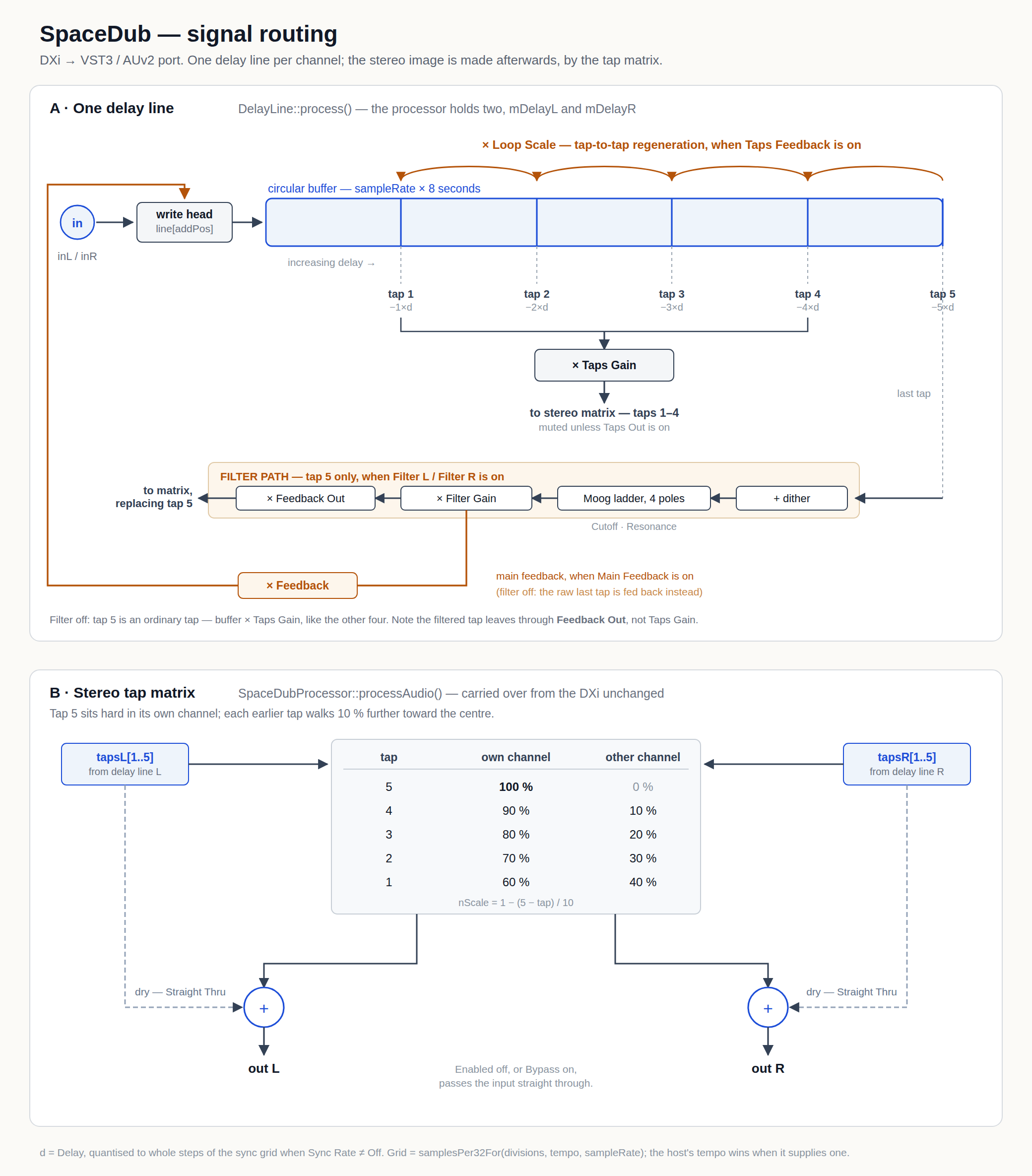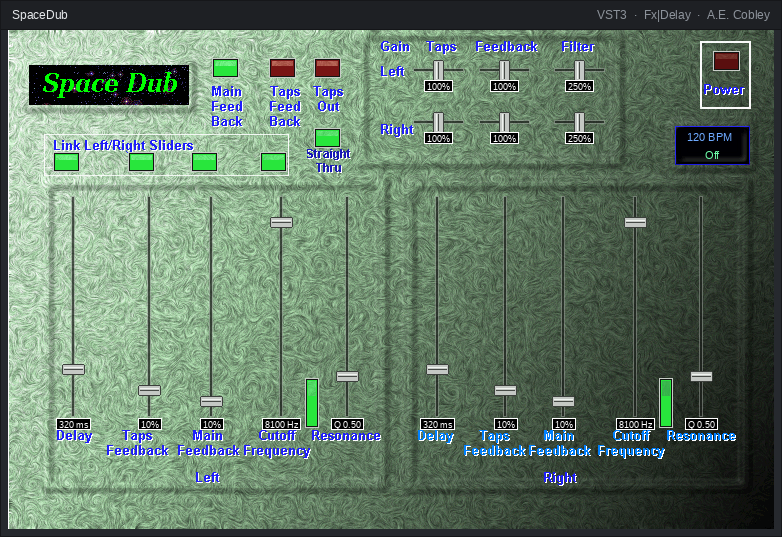
SpaceDub is a five-tap stereo dub delay with a resonant ladder filter in the feedback path. Each channel runs an eight-second delay line read at five taps. The taps are panned by index — the last one hard in its own channel, each earlier one 10 % further toward the centre — so repeats spread across the image as they decay.
Tap 5 can be routed through a four-pole Moog-style ladder filter with cutoff, resonance and gain, and fed back into the line, which is where the dub-siren sweeps come from. A separate tap-to-tap regeneration path lets each tap feed the one before it.
The delay runs free or locks to the host tempo, quantised to a grid from 1/32 to a whole note. When the host supplies a tempo the delay follows it live, and the panel shows the tempo it is locked to.
This is a port of the 2003 Windows Cakewalk DXi of the same name. The DSP is carried over line by line, so it sounds like the original; four places deliberately differ, and each is recorded in the porting notes.
New in 2.0.1.0
The maker is now “AE Cobley”, in both formats — it was “A. E. Cobley”. REAPER files an Audio Unit's presets under its name cut off at the first full stop, so every A. E. Cobley Audio Unit shared one REAPER preset list and showed the others' presets, which did nothing when chosen. The plug-in's identity codes are unchanged, so projects saved with earlier versions still open with SpaceDub in place. Hosts that list plug-ins by maker now show it under AE Cobley. Nothing in the sound changed.
After upgrading. Presets you saved in a
host that files them by maker are in
~/Library/Audio/Presets/A. E. Cobley/SpaceDub
— move them to
~/Library/Audio/Presets/AE Cobley/SpaceDub to see them
again. In REAPER, Audio Unit presets you saved earlier stay in its old
shared list; the VST3 is unaffected.
Three things that look like faults and are not
It makes no sound until you switch it on. The
Enabled switch starts off, exactly as the original
shipped. Until it is lit the plug-in passes audio straight through. This is
the first thing anyone reports.
Filter Gain starts at 250 %. Also as the original shipped. Combined with resonance it is loud by design — bring it down before raising feedback.
Sync Rate has eight entries but seven distinct
values. The DXi's switch mapped both of the last two
to a whole note. Kept, so automation values line up with the original.
Two more worth knowing
- Presets saved by the Windows DXi cannot be read. The value ranges and the stream layout both changed in the port; there is no conversion path.
Feedback Outdoes not change how much regenerates. It scales the filtered tap on its way out, after the point where feedback is taken. The routing drawing below shows why — this is inherited from the original, not a bug.
Three details in the routing that are easy to get wrong
All three are deliberate behaviour inherited from the DXi:
- The filtered tap leaves through Feedback Out, not Taps Gain — unlike the other four taps.
- Main feedback is tapped after Filter Gain but before Feedback Out, so the amount fed back is not the amount you hear.
- With the filter off, the signal fed back is the raw last tap.
Known gaps
- No preset library ships with it; the defaults are the DXi's.
- The five taps are evenly spaced. The original had no way to offset them individually either.
Uninstalling
A .pkg never will, so:
sudo rm -rf /Library/Audio/Plug-Ins/VST3/SpaceDub.vst3sudo rm -rf /Library/Audio/Plug-Ins/Components/SpaceDub.component